
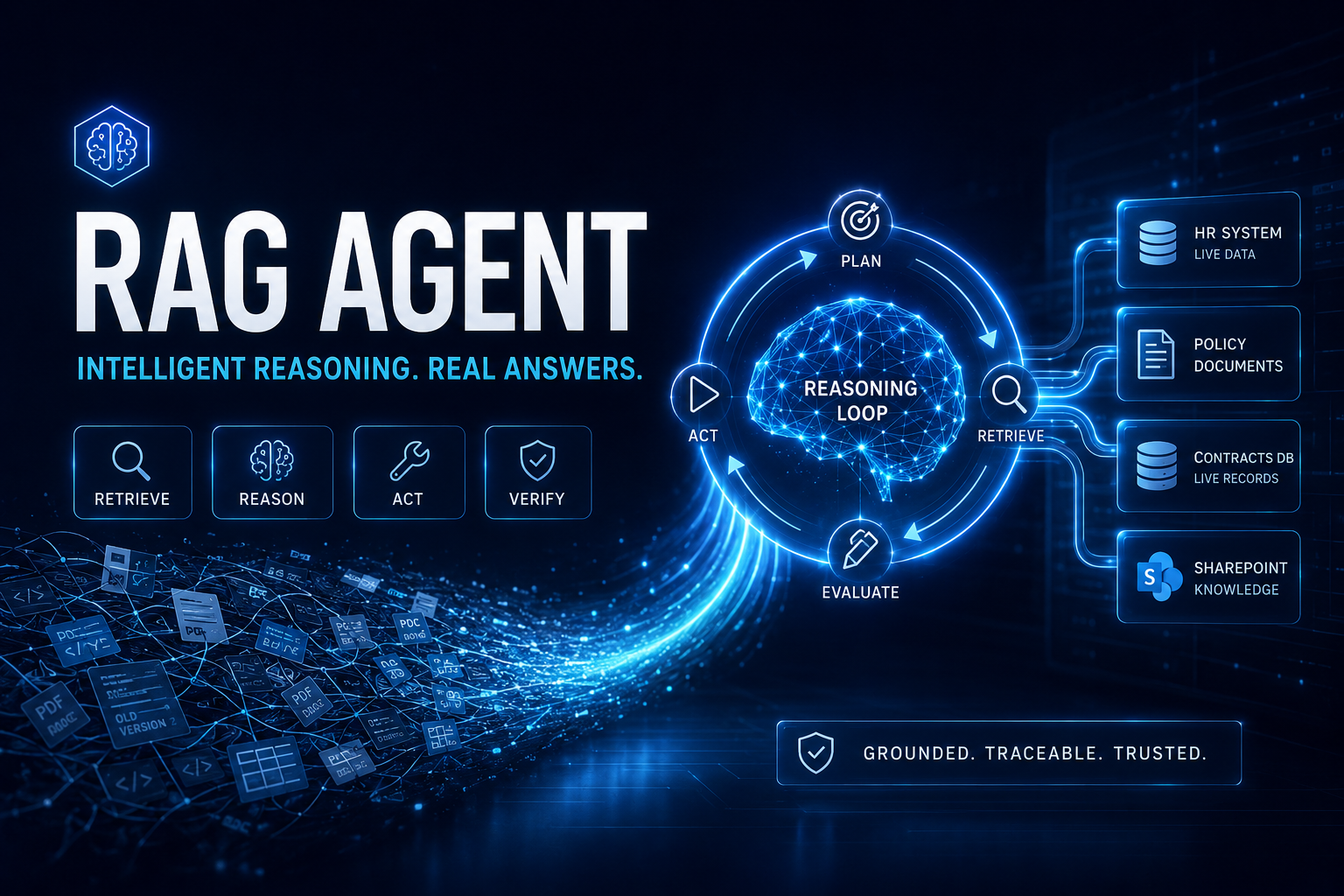
You deploy a RAG chatbot over your internal knowledge base. For the first two weeks, it feels like magic. Then the complaints start rolling in. It pulls the wrong version of a compliance policy. It can’t remember what it told a colleague three questions ago. It confidently retrieves a section from an archived document that was superseded 18 months back. And when a user asks a question that requires cross-referencing your HR system, a live contracts database, and a PDF that lived in SharePoint the bot just guesses.
This is the ceiling of a standard RAG pipeline. And it’s the exact problem that a RAG agent is designed to solve. Not by replacing retrieval, but by wrapping it inside something smarter.
Quick Answer: What is a rag agent?
A RAG agent is an AI system that retrieves information from external data sources and uses an autonomous reasoning loop to decide what to retrieve, when to retrieve it, and how to act on the results rather than following a fixed, one-shot pipeline.
By the time you finish reading this, you’ll be able to explain a RAG agent architecture to your CTO in a ten-minute whiteboard session and you’ll have a clear framework for deciding whether it belongs on your roadmap this quarter or next year.
Before RAG Agents: Why Static Pipelines Hit a Ceiling
To understand what a RAG agent actually is, it helps to be precise about what standard RAG does and why it eventually runs out of road in complex enterprise environments.
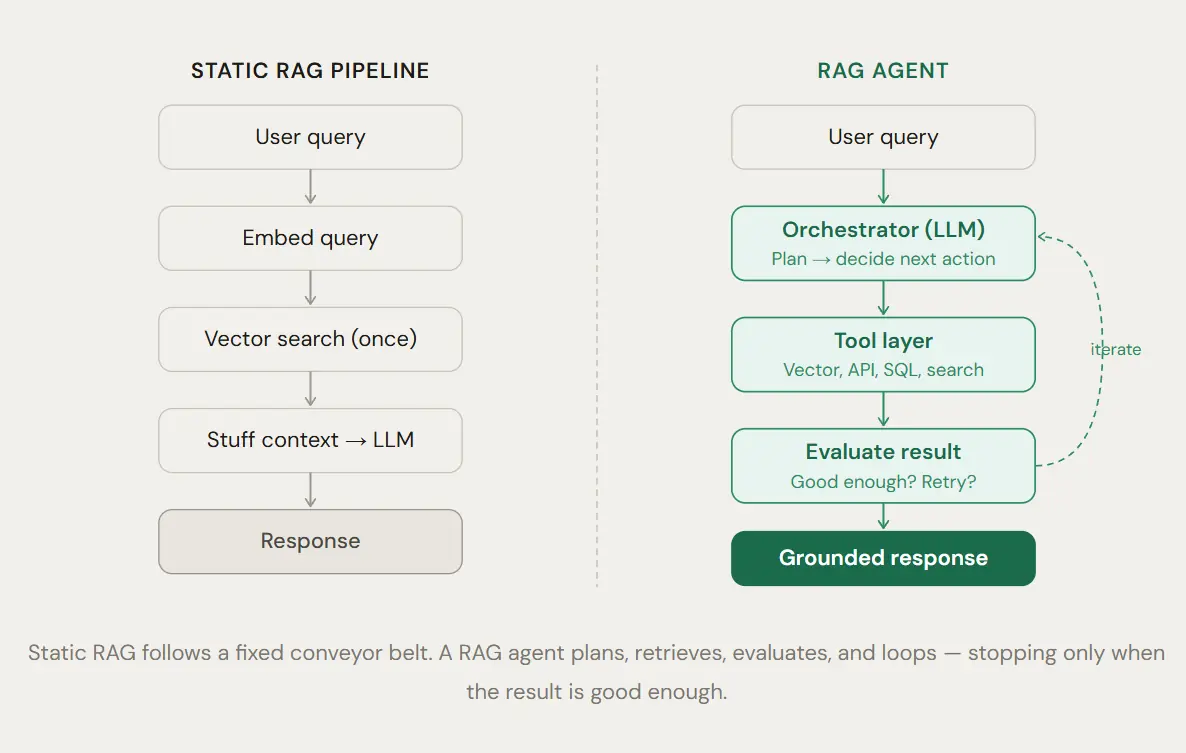
A standard RAG pipeline is elegant in its simplicity: a user asks a question, that question gets converted into a vector embedding, a similarity search pulls the most relevant document chunks from a vector store, those chunks get stuffed into an LLM prompt, and the model generates a response grounded in retrieved content. Clean, fast, and genuinely useful for narrow, well-scoped use cases.
But three structural limitations consistently emerge once you take this architecture past a proof-of-concept:
Single-pass retrieval. The pipeline retrieves once per query, based on that query as written. There’s no self-correction. If the initial retrieval comes back with marginally relevant chunks, the model works with what it has. There’s no mechanism to say “this isn’t quite right let me rephrase and try again.”
No tool awareness. A static RAG pipeline can only reach into a vector store. It can’t call a live API, query a CRM record, run a calculation, or check a current approval status. Every query that needs live structured data hits a hard wall.
Zero state or memory. Each query is processed in isolation. The pipeline has no concept of the conversation thread, prior context, or session history. This is fine for one-off lookups; it’s a serious problem for anything that unfolds over multiple turns.
Real-World Consequence
A compliance team asks a question that requires cross-referencing three policy documents against a live HR system and an active contract record. Static RAG can retrieve part of the answer. It can’t reason across the sources, can’t verify which document version is current, and can’t surface the conflict between the HR policy and the contract clause. It either guesses or silently returns an incomplete answer and the user has no way to know which.
The agentic layer exists specifically to close these gaps. Not by rebuilding retrieval from scratch, but by placing an autonomous reasoning loop around it.
What Is a RAG Agent? (The Clear, Working Definition)
The Plain-English Definition
A RAG agent wraps retrieval inside an autonomous reasoning loop often called an agent loop or ReAct loop. The critical difference is that the agent doesn’t just retrieve. It plans what to retrieve, evaluates whether the result is good enough, and decides what to do next based on that evaluation.
Think of it this way: a static RAG pipeline is a conveyor belt. You put in a question, it goes through fixed stations, you get an output. A RAG agent is a junior analyst with access to multiple filing cabinets, a phone, a calculator, and a critical eye. They don’t just pull the first thing they find they cross-check, follow up, and tell you when they’re not sure.
The word “agent” isn’t marketing language. It borrows from classical AI agent theory: an entity that perceives an environment, reasons about what it knows, and takes actions to achieve a goal. In this architecture, the LLM becomes the reasoning engine. Retrieval becomes one of several tools it can choose to invoke. The agent wraps RAG RAG is still happening, it’s just no longer driving the car.
| Dimension | Static RAG Pipeline | RAG Agent |
| Retrieval timing | Once, upfront | Iterative, on-demand |
| Query strategy | Fixed as submitted | Dynamically rewritten |
| Tool use | None | APIs, DBs, calculators |
| State / memory | None (stateless) | Session + optional long-term |
| Decision-making | Zero | Plan → Act → Reflect |
| Self-correction | None | Built-in retry logic |
The Anatomy of a RAG Agent: How It Actually Works
Let’s break down the five components that make up a production-grade RAG agent, and what each one actually contributes to the system.
01 The Orchestrator
The LLM acting as the brain. Holds the reasoning thread, decides the next action, and doesn’t generate a final output until it has enough information.
02 The Retriever (upgraded)
Not a single vector search. Can be dense, sparse (BM25), hybrid, or graph-based. The agent can rewrite the query and retry if the first result is poor quality.
03 The Tool Layer
What separates an agent from a pipeline visually. Vector stores, SQL, REST APIs, web search, calculators. The LLM selects which tool to call based on what it needs next.
04 Memory
Short-term: conversation window and reasoning trace. Long-term: persistent storage of user context, prior decisions, domain facts. Enables multi-turn coherence.
05 Reflection Layer
Often overlooked but critical in production. The agent evaluates its own output: self-critique prompting, confidence scoring, hallucination checks before the final response surfaces.
The Reasoning Loop, Visualized
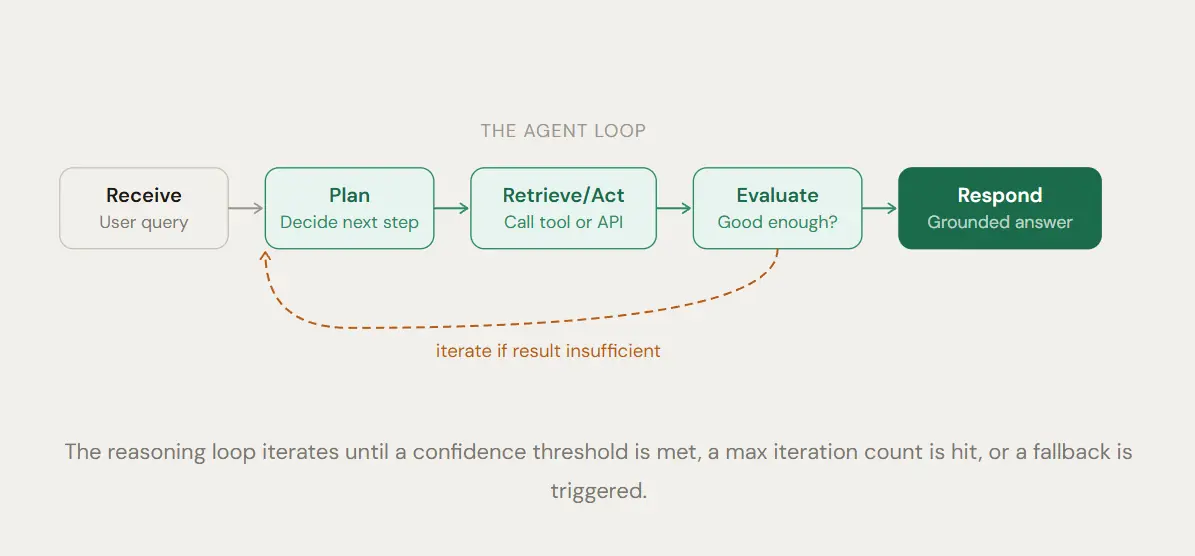
The agent loop can be described in five plain steps: Receive → Plan → Retrieve/Act → Evaluate → Iterate or Respond.
The loop breaks when one of three conditions is met: a confidence threshold is satisfied, the maximum iteration count is reached, or a tool error triggers a graceful fallback. In practice, most well-designed agents resolve complex queries in two to four iterations. If you’re seeing five or six consistently, that’s usually a signal that the retrieval quality or the system prompt needs work not that you need more compute.
RAG Agent vs. the Things People Confuse It With
RAG Agent vs. Fine-Tuned Model
Fine-tuning bakes knowledge directly into the model’s weights. It’s expensive, time-consuming, and critically it freezes knowledge at training time. The moment your internal policy changes, your fine-tuned model is out of date. A RAG agent retrieves live data, making it far better suited for fast-changing internal knowledge bases. That said, fine-tuning still wins in narrow, stable domains with high latency sensitivity think specialized medical coding or legal clause classification where the vocabulary is fixed and sub-second responses are required.
RAG Agent vs. General AI Agent (No Retrieval)
A general AI agent uses tools and reasons autonomously, but may rely entirely on parametric knowledge what was baked in during training. A RAG agent specifically grounds its reasoning in retrieved, cited, up-to-date documents. This distinction matters enormously for compliance use cases: with a RAG agent, you can trace which document drove which answer. With a purely parametric agent, you can’t.
Governance Signal
Auditability is the primary differentiator between RAG agents and parametric agents in regulated industries. If your compliance team needs to show regulators why an AI system gave a particular answer, retrieval grounding with logged source citations is what makes that possible.
Where RAG Agents Deliver Real ROI in the Enterprise
-
Corporate Knowledge Management
Queries spanning HR policy, legal docs, finance SOPs the agent routes to the right retrieval source per query type, cross-references versions, and surfaces conflicts. One mid-market professional services firm we’ve observed reduced internal ticket deflection time from 3.6 hours to around 1.9 hours after deploying an agentic knowledge layer over their Confluence and SharePoint environments.
-
Regulatory and Compliance Q&A
The agent retrieves the relevant regulation text, checks the update date, cross-references internal policy, and flags conflicts. The full retrieval chain is logged meeting the auditability requirements that legal and risk teams actually care about in enterprise deployments.
-
Customer-Facing Support with Escalation Logic
The agent handles L1 queries with retrieval, remembers what it already told the customer earlier in the session, and routes to a human agent when its confidence falls below a configurable threshold. The result is fewer misdirected escalations and higher first-contact resolution rates.
-
Internal Developer and Engineering Assistants
Retrieves from codebase docs, runbooks, architecture decision records routing technical queries to the appropriate index. Particularly effective when engineers are onboarding or debugging unfamiliar services, where the query complexity typically requires multi-source lookup.
Mid-Market Financial Services Firm Internal Policy Assistant
A financial services company operating across three jurisdictions deployed a RAG agent over their compliance documentation, HR system, and contracts database. Before implementation, their compliance team averaged 4.1 hours to answer cross-functional policy questions that required input from multiple departments. After six months of production deployment, that figure had dropped to approximately 1.7-2.2 hours depending on query complexity, with 78% of questions handled end-to-end without human escalation.
The critical enabler wasn’t the agent framework itself it was the retrieval quality audit they ran in the first two months. The initial vector search precision on their legacy documents was around 61%. Once they re-chunked and re-indexed, it rose to 79%, and only then did the agentic reasoning loop start delivering consistent results.
-
Avg. response time before: 4.1h
-
After deployment: 1.9h
-
No-escalation resolution: 78%
Where RAG Agents Are Not the Right Fit (Yet)
It’s equally important to know when to hold off. RAG agents are not well-suited for real-time streaming data with sub-second latency requirements. For narrow Q&A over a single, stable document, a static RAG pipeline is simpler, cheaper, and more predictable. And in highly regulated workflows requiring fully deterministic outputs, the non-deterministic nature of an agentic reasoning loop can create compliance risk rather than reduce it.
The Honest Tradeoffs: What Nobody Tells You Before You Deploy
Latency Is the Silent Project Killer
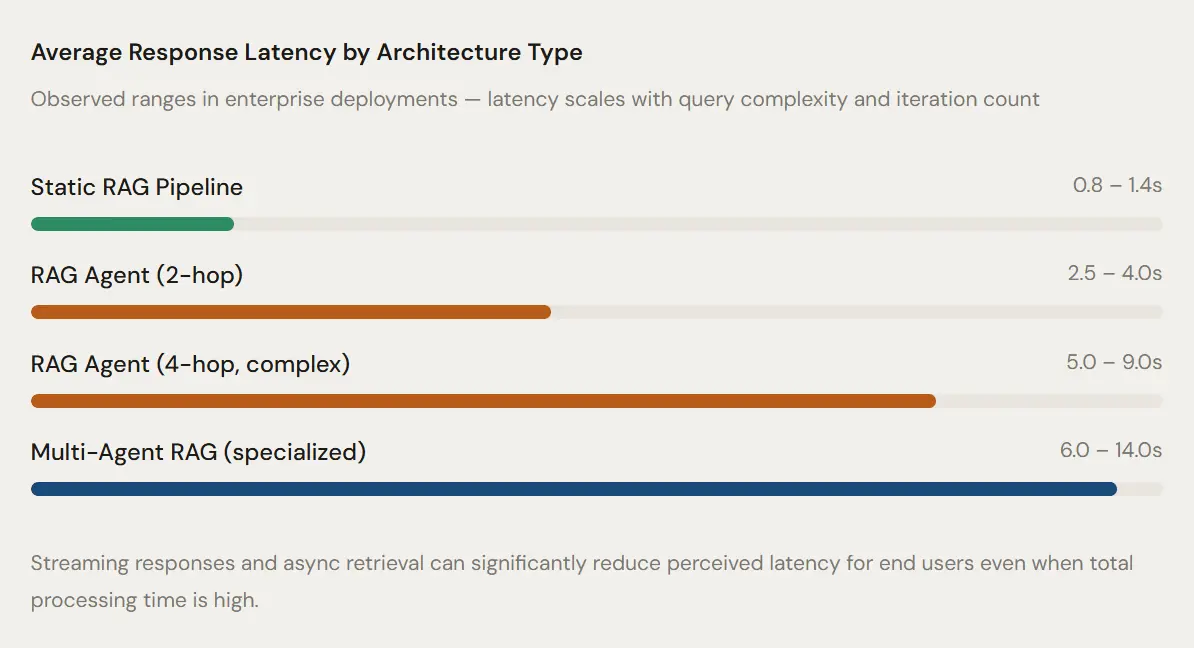
Every agent loop iteration adds latency. Each LLM call plus each retrieval round trip compounds. Multi-hop reasoning can mean 4-6 LLM calls per user query, adding 3-8 seconds to response time. Mitigation: streaming responses, async retrieval, and caching frequent query patterns. If your use case needs sub-second responses, redesign the interaction model before adding agentic layers.
Retrieval Quality Is Still the Bottleneck
An agentic loop cannot save a poorly chunked, poorly indexed knowledge base. The agent will confidently retrieve the wrong thing. Your embedding model and chunking strategy matter more than your choice of agent framework. If your vector search precision is below around 70%, fix retrieval before you build any agent logic on top of it.
Hallucinations Change Shape, Not Frequency
Static RAG hallucinates when context is missing. RAG agents can hallucinate in the reasoning steps themselves wrong tool selection, incorrect query rewriting, faulty multi-hop inference. Mitigation requires citation enforcement in the system prompt, source grounding, and a reflection layer that validates output before it surfaces to users.
Governance Is Non-Negotiable at Scale
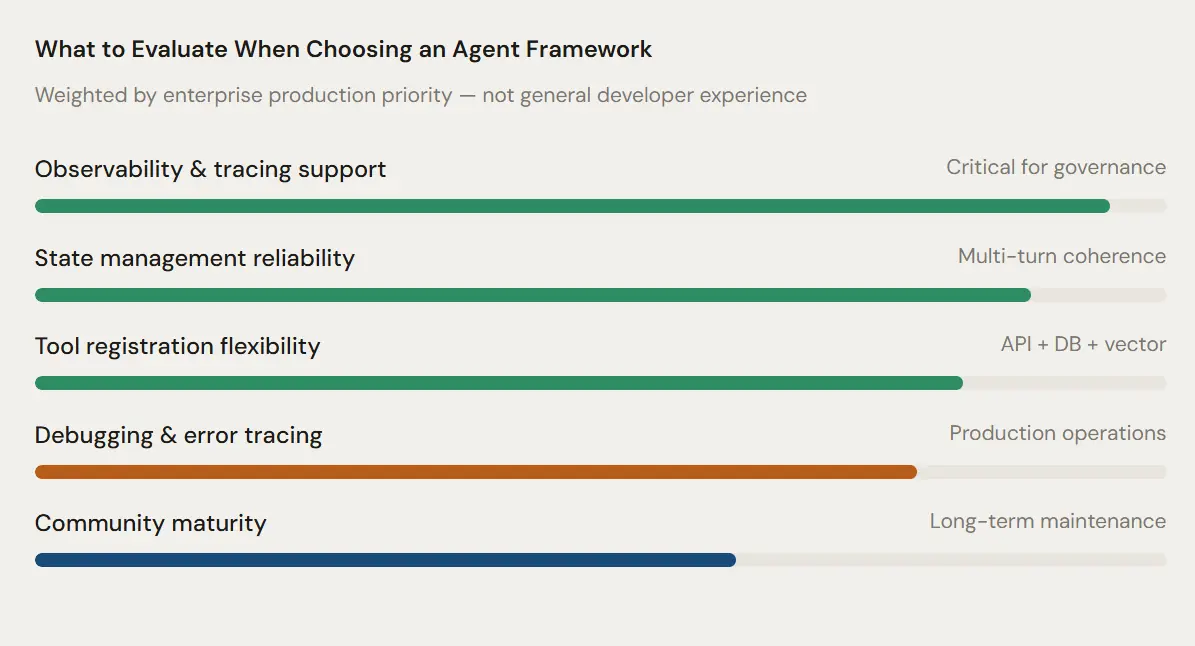
Enterprise deployments need a full trace of every agent decision: retrieval sources logged, tool calls auditable, reasoning steps inspectable. Frameworks vary widely in observability support evaluate this before framework selection. Without tracing, debugging a bad response at production volume is nearly impossible.
How to Evaluate Whether You’re Ready to Build One
Before selecting a framework or writing a single line of orchestration code, work through these five questions honestly. They’ll tell you whether you have a clear runway or whether you’re about to build on sand.
-
Data quality: Is your internal knowledge base cleaned, correctly chunked, and properly indexed? If not start there. An agent cannot fix bad retrieval.
-
Query complexity: Do your users’ questions require multi-source lookup or multi-step reasoning? If yes, the agent layer is justified. If they’re asking single-document lookups, static RAG is cheaper and more predictable.
-
Latency tolerance: Can your use case absorb 3-8 second response times? If sub-second is a hard requirement, you need to redesign the interaction model before adding agentic loops.
-
Observability infrastructure: Do you have logging and tracing in place to monitor agent decisions in production? Without this, debugging at scale is essentially impossible.
-
Team capability: Does your team have real experience with prompt engineering and agent orchestration patterns? Or will this become an opaque black box that nobody can maintain six months from now?
Decision Gate
If you answered yes to questions 1, 2, and 4 you have a viable path. If question 3 is a hard blocker, solve the user interaction model first (streaming, progressive disclosure) before the architecture conversation. Teams that skip the readiness check typically spend the first three months in production debugging things that should have been caught before the first sprint.
How RAG Agents Are Built: A Framework-Level Overview
You don’t need to understand every line of orchestration code to make smart architectural decisions. What you need is a mental model of the three layers you’re actually assembling and where the real leverage points are.
The Three Layers You’re Assembling
The retrieval layer is your vector store (Pinecone, Weaviate, pgvector, and others), your embedding model, and your chunking logic. This layer determines the ceiling of your system’s quality. A bad retrieval layer is unfixable by any amount of agentic sophistication layered on top.
The orchestration layer is the agent framework that manages the reasoning loop LangGraph, LlamaIndex Workflows, AutoGen, and custom implementations are the most common enterprise choices. This is where the plan-act-reflect cycle actually runs.
The LLM layer is the reasoning engine itself. Model selection here affects cost, latency, and instruction-following quality. Smaller, faster models often work well for routing decisions; larger models are worth the cost for complex multi-hop reasoning over ambiguous documents.
Framework Selection: What Actually Matters
Enterprise teams consistently rank native observability support as the top framework criterion not because it’s the flashiest feature, but because without it, production debugging is a nightmare. Frameworks that ship with native LangSmith integration or OpenTelemetry support dramatically reduce governance risk over time.
The Build Sequence That Prevents Rework
Start by proving retrieval quality before touching any agent logic. Then define your tool set (what sources and APIs does the agent actually need?). Design the routing logic next (how does the agent decide which tool to call?). Add the reflection and critique step last, once the core loop is working. Instrument everything before you go anywhere near production. Teams that skip any of these steps in order almost always pay for it later.
How to Explain a RAG Agent to Your C-Suite
Most technical content about RAG agents is written for builders. But someone in the room has to sell the architecture internally and the language that lands in whiteboard sessions is very different from what you’d write in a design document.
The Analogy That Works in Boardrooms
It’s like giving our existing search system a junior analyst who knows which filing cabinet to open, can cross-check two sources before answering, and flags when they’re not sure instead of just guessing.
Replace every technical term before it leaves your mouth. “Vector embeddings” becomes “how the system understands meaning.” “ReAct loop” becomes “the back-and-forth thinking process.” “Multi-hop reasoning” becomes “following up on an answer before treating it as final.”
Lead with three business outcomes not technical features. First, faster access to institutional knowledge reduce time-to-answer for internal teams who currently wade through SharePoint and Confluence manually. Second, reduced hallucination risk compared to a plain LLM chatbot because every answer is grounded in your actual documents, not trained weights from 18 months ago. Third, auditability you can see what the system retrieved and why it said what it said, which matters for compliance, legal, and risk teams.
What’s Next: Where RAG Agents Are Heading
Multi-agent RAG, Adaptive retrieval, Governance tooling, Memory persistence, Agent-to-agent routing, Live data grounding
The most significant architectural pattern emerging in large enterprise deployments is multi-agent RAG: multiple specialized agents one for HR documents, one for finance data, one for legal filings coordinated by a router agent that understands which specialist to hand a query to. This reduces retrieval noise considerably, because each agent operates over a narrowly scoped, well-indexed domain rather than a single massive vector store.
Adaptive retrieval is the other major trajectory agents that learn over time which retrieval strategy works best for a given query type, moving beyond static hybrid search configurations toward dynamic strategy selection per query class.
The market gap right now is observability and governance tooling and it’s closing fast. For anyone evaluating RAG agent platforms with compliance as a priority requirement, this is the most important capability to benchmark. Expect this tooling to mature significantly over the next 12 months, which will meaningfully lower the barrier to enterprise adoption.
The longer signal worth watching: as memory and action layers mature, the boundary between a RAG agent and an “AI employee” will blur. That’s an organizational change management question as much as a technology one worth raising with your leadership team well before the architecture decision, not after.
The same knowledge base that stumped your static RAG chatbot the one that retrieved the wrong policy version, ignored session context, and couldn’t touch the HR system becomes tractable the moment you wrap retrieval inside an autonomous reasoning loop. The agent plans its retrieval strategy, evaluates the result, cross-references the live HR system, and flags uncertainty before it reaches the user. That’s not a smarter chatbot. It’s a reasoning system that happens to use retrieval as one of its tools.
If the five-question readiness checklist above returned mostly yes answers, your next step is a retrieval quality audit not a framework selection conversation. Fix the foundation first. The agentic layer is only as good as what it has to work with.
Frequently Asked Questions
What is a RAG agent in AI?
A RAG agent (Retrieval-Augmented Generation agent) is an AI system that combines an LLM’s reasoning capabilities with an autonomous loop for retrieving external information. Unlike a static RAG pipeline that retrieves once per query, a RAG agent plans what to retrieve, evaluates the results, and can retry or call additional tools before generating a final response.
What is the difference between RAG and a RAG agent?
Standard RAG is a fixed pipeline: query → embed → retrieve → generate. A RAG agent wraps retrieval inside an autonomous reasoning loop, giving the system the ability to rewrite queries, call multiple tools, maintain session memory, and evaluate its own outputs none of which a static pipeline can do.
What are the key components of a RAG agent?
The five core components are: (1) an orchestrator LLM that manages the reasoning thread, (2) an upgraded retriever capable of multiple search strategies, (3) a tool layer for APIs, databases, and calculators, (4) a memory module for short-term and optional long-term context, and (5) a reflection or critique layer that validates output quality before the response surfaces to users.
How do I build a RAG agent?
Start by proving retrieval quality in isolation get your vector search precision above 70% before adding any agent logic. Then define your tool set, design routing logic, add a reflection step, and instrument everything for observability. Common orchestration frameworks include LangGraph, LlamaIndex Workflows, and AutoGen.
What are the best RAG AI agent platforms for governance?
Evaluate frameworks on their native observability support specifically whether they offer built-in trace logging, source citation enforcement, and OpenTelemetry or LangSmith integration. Platforms that log the full retrieval chain and tool call sequence are significantly easier to audit in regulated environments.
Do RAG agents eliminate hallucinations?
No. They change the shape of hallucinations rather than eliminating them. Static RAG hallucinates when context is missing. RAG agents can hallucinate in the reasoning steps wrong tool selection, incorrect query rewriting, faulty multi-step inference. Mitigation requires citation enforcement, source grounding in the system prompt, and a reflection layer.
How slow are RAG agents compared to standard RAG?
Significantly slower for complex queries. A static RAG pipeline typically responds in 0.8-1.4 seconds. A RAG agent with two reasoning hops averages 2.5-4.0 seconds; a four-hop complex query can take 5-9 seconds. Streaming responses and asynchronous retrieval can reduce perceived latency considerably for end users.
When should I use a RAG agent vs. a fine-tuned model?
Use a RAG agent when your knowledge base changes frequently, when queries span multiple sources, or when auditability is required. Use fine-tuning when your domain is narrow and stable, latency is critical, and you can afford to retrain periodically. They’re not mutually exclusive some production systems combine both approaches.
What is multi-agent RAG?
Multi-agent RAG involves multiple specialized agents one for HR documents, one for finance data, one for legal filings coordinated by a router agent. Each specialist operates over a narrowly scoped, well-indexed domain, which reduces retrieval noise and improves answer precision compared to a single agent operating over a massive unified vector store.
What is the ReAct loop in a RAG agent?
ReAct (Reason + Act) is the pattern where the LLM alternates between reasoning about what to do next and taking an action like retrieving a document or calling an API. The loop continues until the model determines it has sufficient information to generate a reliable, grounded response.
Is RAG in AI the same as a RAG agent?
No. RAG (Retrieval-Augmented Generation) is a technique for grounding LLM outputs in retrieved documents. A RAG agent is a system that uses RAG as part of an autonomous reasoning loop it decides when and how to retrieve, rather than always retrieving the same way. All RAG agents use RAG; not all RAG systems are agents.
What’s the first step before building a RAG agent?
A retrieval quality audit. Check your vector search precision on real user queries if it’s below around 70%, improving chunking strategy, metadata tagging, and embedding model selection will deliver far more value than any agent framework you could choose. Retrieval quality is the foundation everything else depends on.
